

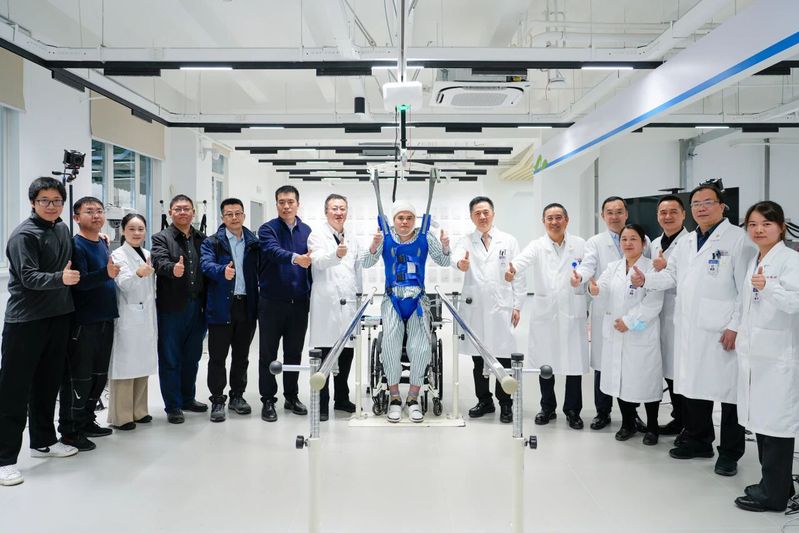
In March, a team led by Associate Researcher JIA Fumin from Fudan University’s Institute of Science and Technology for Brain-inspired Intelligence (ISTBI), in collaboration with Fudan University Zhongshan and Huashan Hospitals, pioneered the world’s first clinical proof-of-concept surgeries using Brain-Spine Interface (BSI) technology. By constructing a neural bridge between the brain and spinal cord via minimally invasive surgery, the team successfully implanted electrodes in just four hours. Remarkably, within 24 hours post-surgery, patients were able to regain leg movement with the assistance of artificial intelligence.
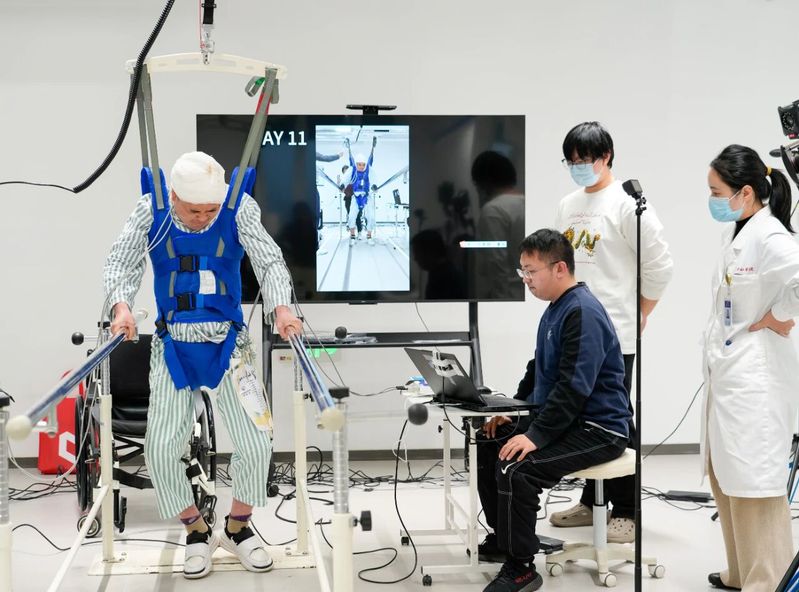
This technology, commercialized by the startup “Wiraxon Co., Ltd.” in partnership with Jia’s research team, has become the first medical device group from China to receive Breakthrough Therapy Designation (BTD) by the U.S. Food and Drug Administration (FDA).
What is FDA Breakthrough Therapy Designation?
The FDA’s BTD is a process designed to expedite the development and approval of new drugs for serious conditions. It requires that a drug demonstrate substantial improvement over existing therapies in early clinical trials. The drug will receive intensive FDA guidance, interdisciplinary collaboration, and accelerated review, with the aim of ensuring effective new therapies reach patients sooner.
From Controlling Machines to Repairing Oneself: A Paradigm Shift
While Brain-Computer Interface (BCI) and Brain-Spine Interface (BSI) differ by only one word, they represent fundamentally different philosophies. BCI typically seeks to read the brain to control external devices, offering functional substitution. In contrast, BSI attempts to build a bridge across severed neural pathways, aiming for fundamental physiological repair and reconstruction. For patients paralyzed by spinal injury, BSI aims to reactivate dormant neural circuit and neural-muscle pathway, offering a way to restore movement and bodily control.
Q: Could you explain the core concept and technology behind your Brain-Spine Interface? How does it differ from traditional therapies?
Jia: The Brain-Spine Interface, which belongs to Class III domestic medical devices, is designed to reconnect the brain and limbs, helping the patient’s brain regain active control over their body. We are currently accelerating our research in this area.
The spinal cord acts as the primary conduit for neural signals between the brain and the body. When damaged, this conduit is disrupted; neural signals cannot reach the limbs, resulting in paralysis.
Our BSI is essentially a “neural bridge”. We chose a difficult technical path, but our validation with the first four patients has shown that, despite the initial challenges of rehabilitation, the technology delivers sound therapeutic effects. We even observed unexpected neural reorganization (neuroplasticity) during the treatment process, which exceeded our expectations.
Q: Treating neurological diseases is notoriously difficult. Compared to traditional drug development and therapy, what unique solution does the BSI offer?
Jia: While immunotherapy and cell therapy are advancing rapidly, progress in treating brain diseases—especially Alzheimer’s—remains slow. This is largely due to the blood-brain barrier, a protective tissue that shields the brain from harmful substances but also blocks most large molecules in the blood, many of which are key therapeutic agents.
However, neuromodulation and physical interventions have inherent targeting capabilities; they can precisely bypass the blood-brain barrier. With our current BSI, we can surgically place electrodes directly into the target area. For example, by targeting the motor cortex through detailed preoperative planning and collaboration with surgeons, we can place electrodes with high precision, solving the delivery problem.
The Dynamic Balance: Technological Liberation vs. Industrial Reality
In a brain and spine surgery, safety is paramount, yet technical goals must constantly iterate—or even overturn—previous standards. The fact that the first clinical patient successfully lifted their leg within 24 hours of surgery far exceeded the team’s expectations, prompting Jia to reflect that only radical visions can drive true paradigm shifts.
Q: Can you share a specific breakthrough moment from the countless late nights of testing that convinced you that you are on the right path?
Jia: We operated on our first patient on January 8 this year. I didn’t sleep the night before. Even though the procedure is relatively safe, I was anxious about potential complications. The moment the surgery ended and the patient woke up safely was one of profound relief—it felt like a huge weight was partially lifted from my shoulders. Our core hypothesis was that our system could reconnect brain and spinal cord signals through acquisition, decoding, and encoding. We had proven it in theory and experiments, but witnessing it work in a human for the first time on January 9 was truly exhilarating. It felt like we had cracked open a door to a new world.
I originally estimated the surgery would last 4 to 5 hours, but the surgery went smoothly and took two hours—I was quite surprised. Any surgery involves trauma, and BSI surgery is no exception. However, the overall operation time is relatively short, and the damage remains within the controllable range.
During our internal review of the first four patients, we re-examined our expected outcomes. Initially, we had projected it would take three weeks for patients to achieve brain-controlled stepping. Everyone thought that goal was too aggressive, yet now it seems almost conservative. While we must remain cautious about surgical risks and device stability, we can afford to be far more ambitious about the potential benefits for patients.
Q: Bridging the gap between lab research and clinical use is a huge challenge. What aspect of that journey is hardest to get right when building a medical device?
Jia: I have been in the neuromodulation field since 2010, spending over a decade on basic research and industrial translation. Since joining Fudan University in 2020, the rise of AI has allowed me to step up the pace on the Brain-Spine Interface. A decade ago, using such technology to treat paralysis seemed an unrealistic dream. Our generation of scientists are given this historic opportunity. What once seemed impossible is now advancing faster than I ever imagined, and I am compelled to pursue it.
Our focus is on medical-engineering convergence: building on lab research to create products that are clinically usable. A new technology might be cool, but we have to ask: How long until it can be used here? If it takes 20 years, it’s not our immediate priority. We are determined to do the hard but right things—defining products that are technically advanced yet clinically accessible, and advancing steadily with moderate iteration.
Helping Paralyzed Patients Recover Movement, Even Running
When a technology becomes sophisticated enough to repair the most delicate living systems, its implications extend far beyond therapy. In essence, a Brain-Spine Interface could redefine the very concept of human-machine fusion. Current humanoid robots have a powerful low-level “cerebellum” for motor control, but lack the high-level processing for intention and adaptation that a “cerebral cortex” provides.
Q: In the next decade, what changes do you hope this technology will bring to patients globally?
Jia: We still know very little about BSI, motor brain decoding and spinal encoding.
Our goal for first-generation BSI is rapid functional reconstruction—crucial because immobility leads to complications. But if a patient can remove the device and still move, that would be the ultimate BSI technology. For instance, is it possible that a patient comes in lying down and walks out a month after surgery? If they can walk with weight support two weeks post-op, can they eventually walk without it?

By 2030, our goal is to help paralyzed patients regain meaningful mobility, with the ultimate aim of enabling them to run on their own legs—whether independently or with the aid of crutches, moving beyond reliance on wheelchairs or robotics. Even if they run slowly—even if it takes ten minutes to finish a 100-meter race—I hope our technology can help them achieve that.
Q: Looking further ahead, what is the ultimate vision for BSI? Will it redefine “health”, or even “humanity”?
Jia: Human death is no longer defined by the cessation of the heartbeat. In the future, artificial hearts, kidneys, and livers will become commonplace. But if the human brain is replaced, are we still ourselves? It seems not.
Currently, BSI operates at the motor level. The nervous system governs three core functions: motion, cognition, and emotion. We chose motion as our entry point because the underlying neuroscience is more established and motor outcomes are easier to quantify. Assessing more abstract human qualities like happiness, by contrast, poses a greater challenge due to the lack of clear, quantifiable metrics. Consequently, I believe progress in motor BSI will be more straightforward, as it builds upon a more solid scientific foundation.
(END)
Writer: Edward Turdmat
Editor: WANG Mengqi, LI Yijie