The 2002 Fields Medalist delivered a lecture at the 17th Shanghai Master Forum on Science at Fudan University, exploring how Grothendieck’s topos theory may illuminate the hidden geometry of artificial intelligence.
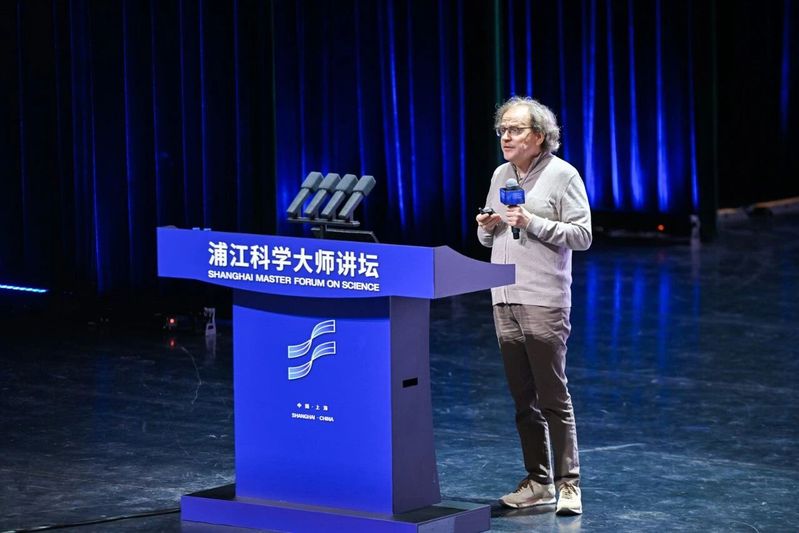
AI can now write poems, paint pictures, even draft mathematics—yet no one can say with certainty what happens inside it. The more powerful AI becomes, the more it resembles a black box. Where should we look for answers? According to Laurent Lafforgue, perhaps in the deepest foundations of mathematics.
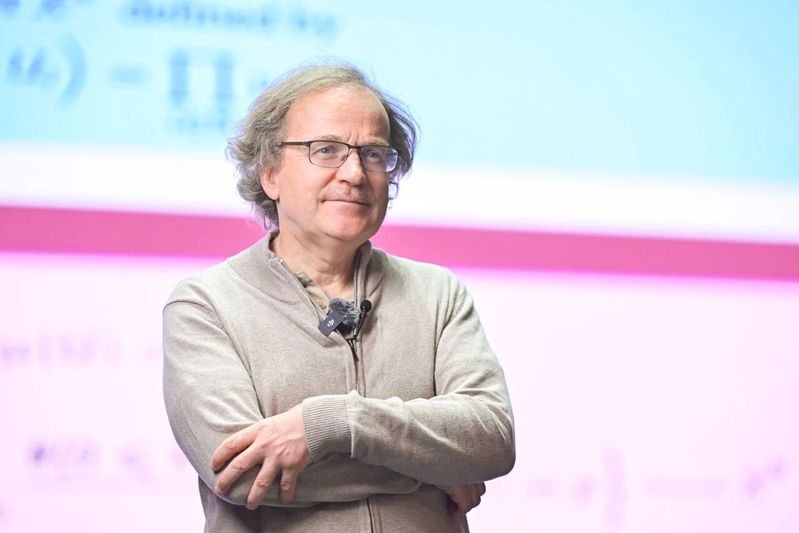
On October 28, the 17th Shanghai Master Forum on Science was held at Fudan University. Laurent Lafforgue—winner of the 2002 Fields Medal, member of the French Academy of Sciences, and senior expert at the Lagrange Center, Huawei Technologies (France)—delivered a lecture entitled “Rethinking points, functions and spaces with Grothendieck, in an attempt to think a little about AI”. He shared his recent reflections on exploring new forms of artificial intelligence through Grothendieck’s theory of toposes with the faculty and students from universities and secondary schools across Shanghai at the Forum.
Can Mathematics “See Through” AI?
Lafforgue opened with the paradox at the heart of today’s large language models (LLMs). A text, he explained, is generated as a continuous stream of “tokens”, each represented by a vector—a string of numbers—whose values are adjusted step by step by algorithms known as “transformers”. The trouble, he noted, is that unlike the vectors representing images, which correspond to physical measurements of light, the vectors representing words “come from no physical measurement at all”. To a mathematician, they even seem arbitrary.
He described AI as “the industrialization of intellectual activity”. The Industrial Revolution of the eighteenth and nineteenth centuries rested on engineers’ understanding of theory and natural law; today’s AI, by contrast, runs on simple mathematics and enormous computing power. Yet there is still no mature, complete theory of text, a gap he found deeply unsatisfying—and one that, in his view, mathematicians could not afford to ignore.
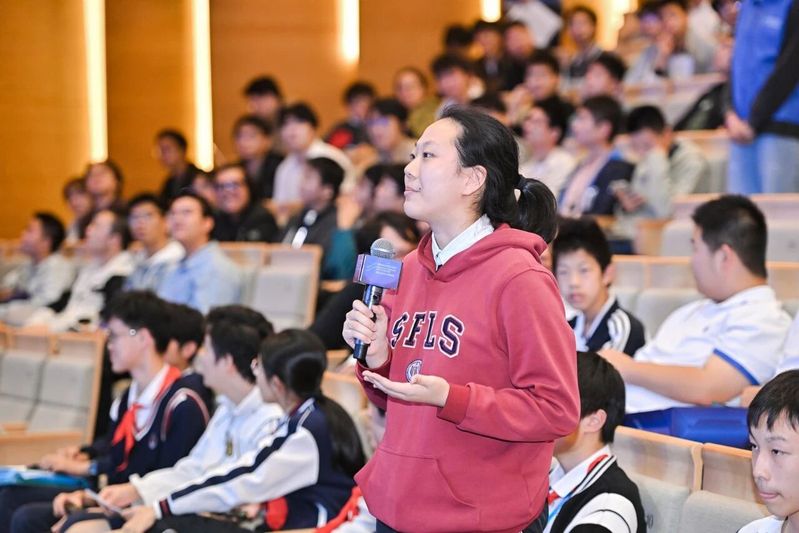
When a student asked whether, given enough data, AI might learn an underlying geometric structure without one being explicitly defined, Lafforgue was skeptical. An LLM, he argued, is essentially a device for computing conditional probabilities—the likelihood that one token follows another, because it learns exclusively from texts written by real people.
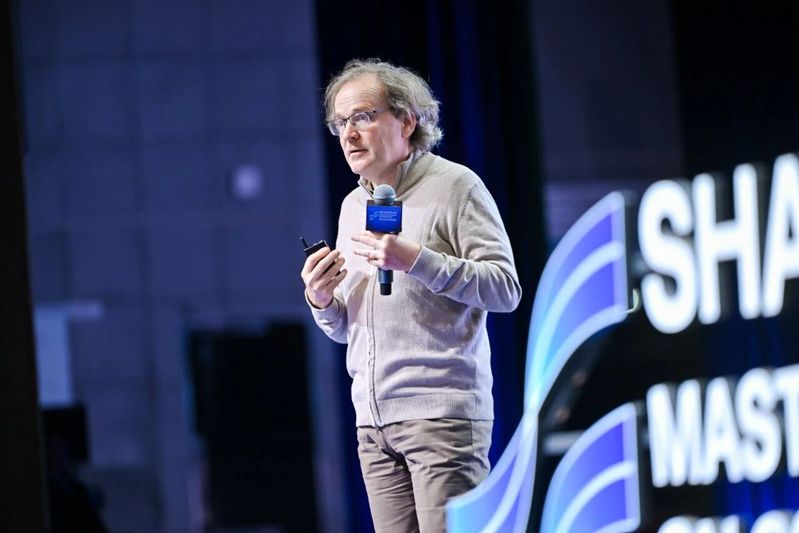
He also pointed to a two-way relationship between mathematics and AI: mathematicians’ texts are the source from which AI learns, but AI may in turn transform the way mathematics is written. The rigorous, proposition-by-proposition style of modern mathematical writing, he recalled, was largely shaped by the Bourbaki school; under AI’s influence, a more literary style might return. “That is my hope,” he said. Mathematics will not perish because of AI—but it may recover its literary and philosophical character or even give birth to an entirely new paradigm.
Finding Abstract Ideas in Everyday Life
Lafforgue said he considered it a miracle that mathematical concepts should feel so close to everyday life.
He illustrated this with the notion of covering. A house is covered brick by brick; a garment is covered piece by piece with cloth. Covering is simply the weaving of small parts into larger wholes—something we experience almost constantly. The same notion, he observed, is inherent in the nature of text: tokens join into sentences, and any short text can be prolonged into longer ones. “Today’s weather” may be continued by “is lovely” or “is fine, perfect for an outing”. A covering, in this sense, means that no possible continuation of a text is left out.
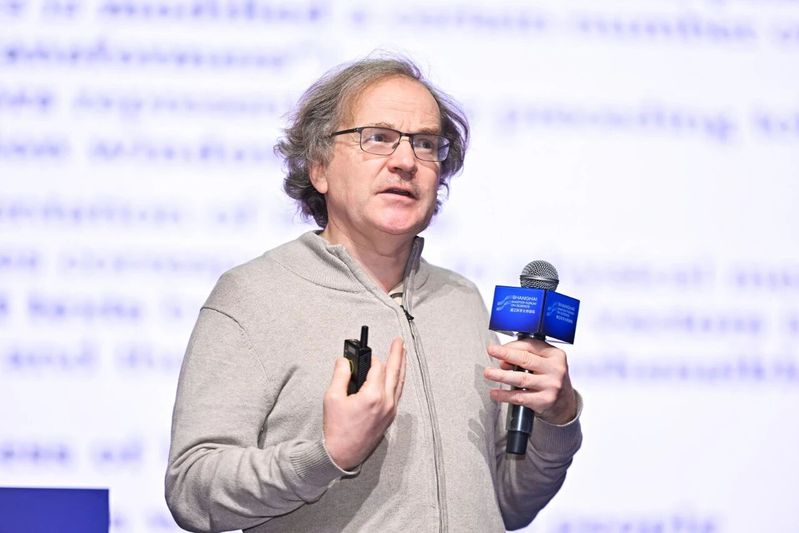
Grothendieck’s decisive move, Lafforgue explained, was to gather “all texts, together with all the ways of continuing them” into a single structure—a topos. Every text becomes a “point” of this space, and the relations between points encode how texts extend from short to long.
He traced the lineage of the idea: Gelfand had associated a space with the algebra of continuous numerical functions on it, converting problems of geometry into problems of algebra. Grothendieck replaced “continuous numerical functions” with “continuous set-valued functions” and discovered that these were equivalent to sheaves of sets—a seemingly unrelated notion. The concept of a sheaf could then be carried to far more general settings, giving rise to toposes as categories of sheaves on a “site”—a category equipped with a notion of covering.
The “Useless” Usefulness of Mathematics
Borrowing a vivid metaphor from a Chinese mathematician, Lafforgue compared pure and applied mathematics to the interlocking halves of the yin-yang diagram: each permeates the other. Finite field theory, founded by the French mathematician Évariste Galois, was regarded for a century and a half as the purest of abstractions with no conceivable application. Today, it underlies WiFi communication, touching the daily life of everyone.
The lesson, he said, is that no one can predict when mathematics will find its use: “It may release its value only many years later.”
On how to study mathematics, Lafforgue offered no shortcut. Even in the age of powerful AI, learning mathematics “remains a very traditional matter”—written expression and hands-on computation matter above all. When tackling a problem, he advised, write down the proof as if explaining it to someone who knows no mathematics at all.
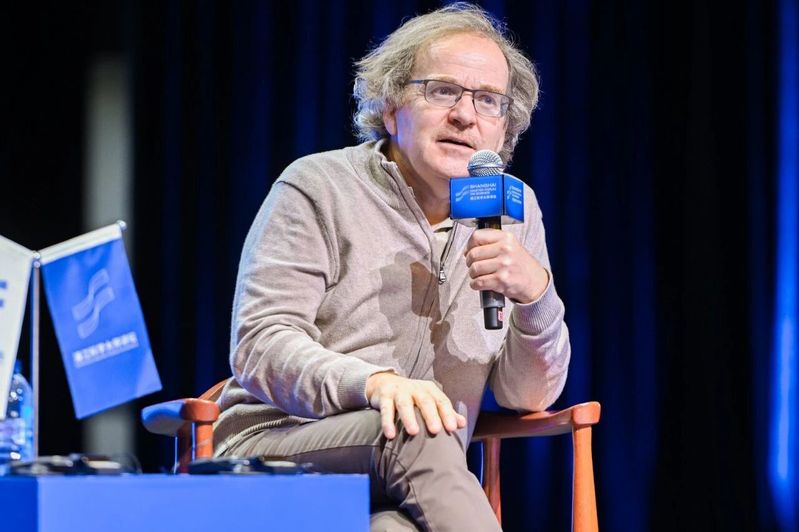
He noted that many French professors speak highly of their Chinese students—diligent, well-prepared, rigorous, and respectful of their teachers—with one small regret: Chinese students are often hesitant to ask questions, sometimes out of excessive deference. Yet in recent months he has observed a heartening change: students first ask AI, and AI’s feedback gives them the confidence to ask further. His advice: ask more questions, even very difficult ones. “Professors are actually delighted with that.”
Across Disciplines, Across Cultures
On October 30, Lafforgue attended the World Laureates Forum in Shanghai, whose hallmark, he said, is interdisciplinary exchange—an event he had taken part in many times. He added that in promoting dialogue across disciplines, China’s academic community was at the forefront of the world. Such dialogue was difficult but worth attempting: bringing together researchers from every field of knowledge was, he reflected, essentially the original purpose of the university.
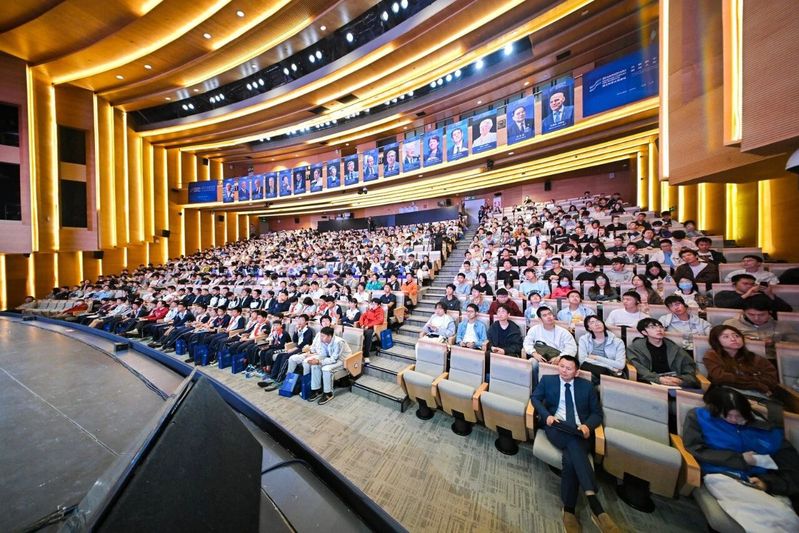
Lafforgue also offered a piece of advice to China’s young mathematicians: even while doing mathematics, do not neglect literature. Literature carries great weight in French culture, and in Chinese culture as well. He believes literary cultivation will become ever more important in the future.
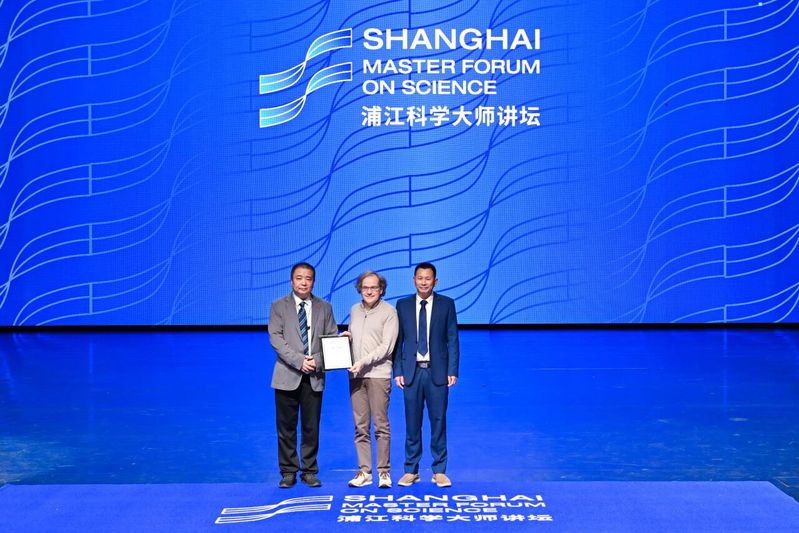
JIN Li, president of Fudan University, an academician of the Chinese Academy of Sciences, attended the forum and presented Lafforgue with a commemorative certificate for the Shanghai Master Forum on Science. The lecture was moderated by PENG Huisheng, assistant to the president of Fudan University and academician of the Chinese Academy of Sciences.
(END)
Writer: YUAN Jiahao, WANG Mengqi
Editor: WANG Mengqi