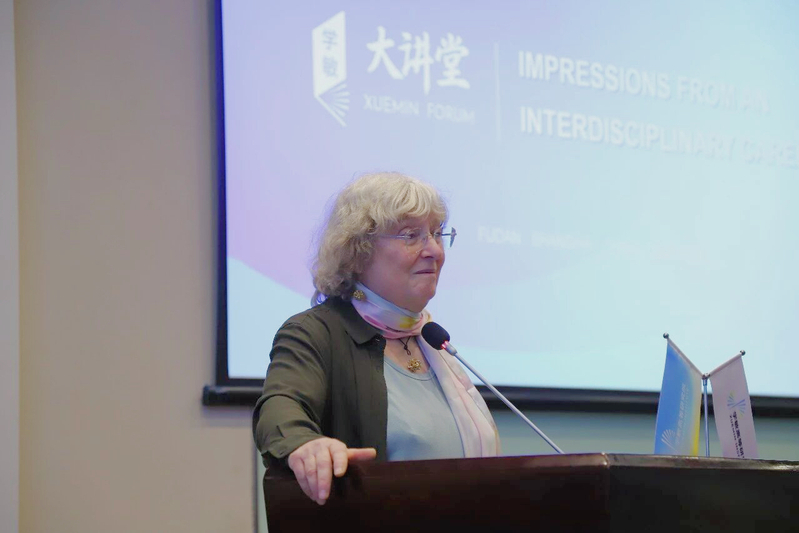
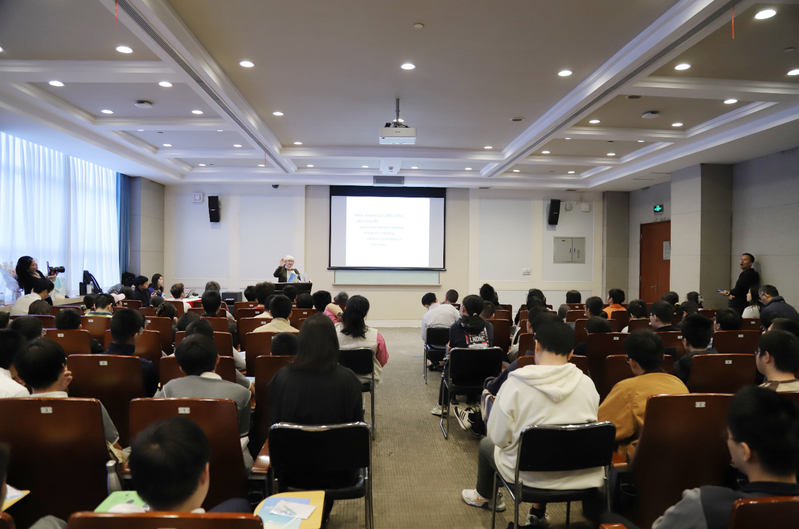
On October 28, a lecture hall at Fudan University was packed with faculty and students eager to hear from Ingrid Daubechies, a 2023 Wolf Prize laureate and one of the most influential mathematicians of our time. A central figure in wavelet theory, she constructed the compactly supported wavelet bases that helped carry wavelets into the JPEG 2000 image compression standard. Yet what she shared went beyond mathematics: how a girl who loved her balance-scale toy grew into a mathematician who built bridges between math and physics, biology, art, and other fields.
The Seed Was There: A Physicist by Training, a Mathematician by Instinct
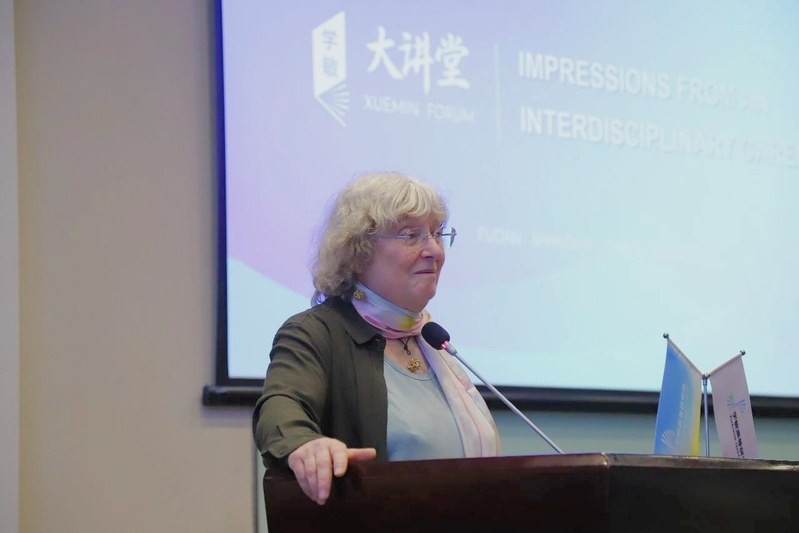
Daubechies opened not with equations but with stories, tracing the arc of her own life. She recalled her favourite childhood toy: a balance with numbered disks and weights. “I thought this was wonderful,” she said. Looking back, the seed of a mathematician, it seemed, was already there.
But her formal training was in physics. Daubechies earned both her bachelor’s and doctoral degrees in physics, and her work was always very theoretical, very mathematical. It was during this period that she worked most closely with Alex Grossmann, a theoretical physicist who helped lay the foundations of wavelet theory and steered her toward the field that would define her career. After her doctorate, she constructed compactly supported orthogonal wavelets and turned them into tools for image compression and signal analysis — tools that would eventually reach into neuroscience, geophysics, art conservation, and many other fields.
Taking Root: A Breakthrough Born of Interdisciplinary Synthesis
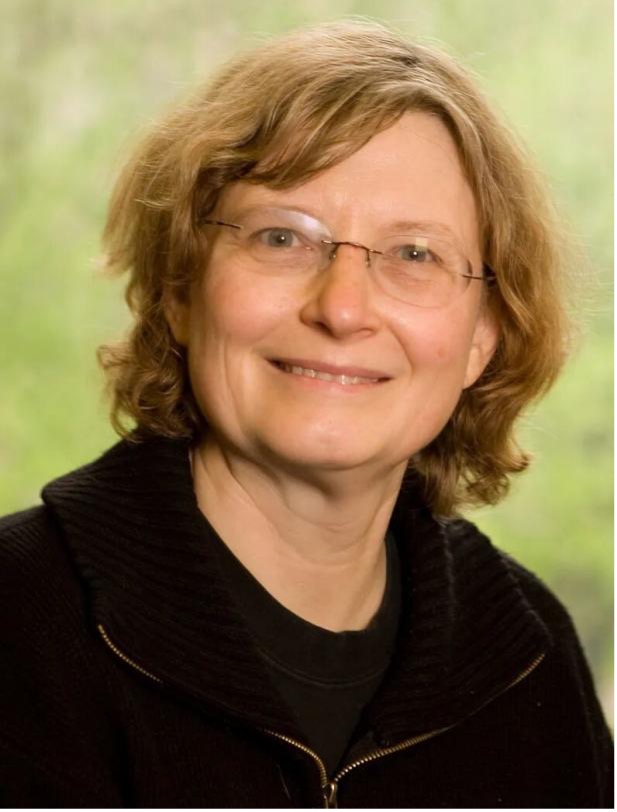
To explain what wavelets are, Daubechies began with sine waves. In mathematical terms, a sine wave stretches forever at a single frequency — it has no start and no end. So, if you take only a short slice of a signal, you cannot tell which frequency it carries; wait long enough to pin down the frequency, and you lose track of when it occurred.
This is the limitation of the classical Fourier transform: because it builds signals out of sine waves, it cannot tell you both what frequencies a signal contains and when they occur. Her answer was to break signals into wavelets — short, localized waveforms that can be stretched, squeezed, and shifted. Because each wavelet lives only in a brief stretch of time, it can capture both what frequency is present and when it occurs — doing what a Fourier transform cannot. That matters because most real-world signals, such as music or heartbeats, change frequency over time. Daubechies’s contribution was to turn the idea of wavelets into a theory both rigorous and practical.
To show what this makes possible, she turned to the pixels of a digital image. A wavelet decomposition breaks an image into building blocks, keeping detail only where it is needed — the logic behind modern image compression, and the logic that carried her wavelets into the JPEG 2000 standard.
Branching Out: Mathematics as a Universal Bridge
“Mathematics gives you a way of thinking, a way of approaching, and a way of framing problems,” she said. For Daubechies, mathematics is far more than an academic pursuit: it is a universal toolkit that opens up problems across nearly every domain of human inquiry. She spoke enthusiastically about the many collaborations she has built with experts in diverse fields.
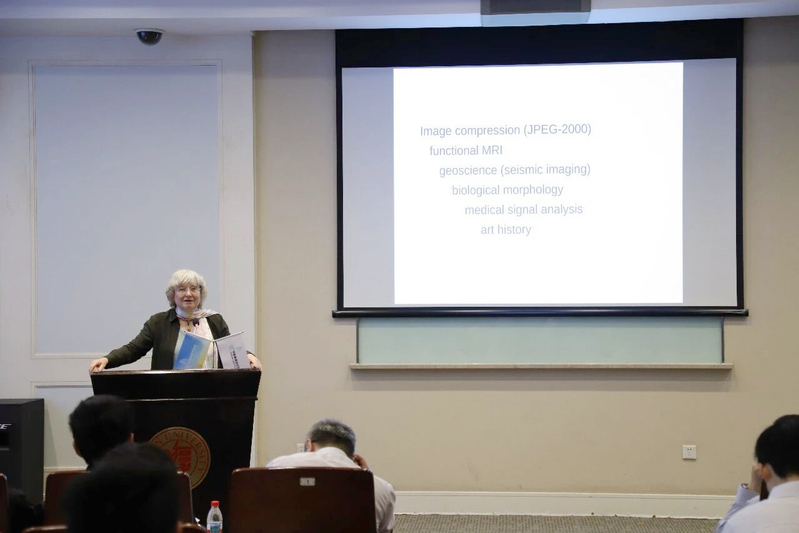
Her wavelets have been applied to problems that are hard to read by eye: the peaks and valleys of a functional MRI scan, the wiggle of a seismogram that reveals what lies beneath the Earth’s surface, the shapes of different species, the overlapping layers of paint in the X-ray of a centuries-old altarpiece. Biologists once had to mark landmarks on each specimen by hand, one at a time; her algorithms let them compare shape at scale. Conservators used the same mathematics for a subtler kind of repair. In the Reunited project she described, her team digitally aged a newly reconstructed altarpiece panel — using algorithms to mimic the color shifts, wear, and patina of age — until it sat convincingly beside its centuries-old neighbors.
Stay Rooted, Stay Curious, and Keep Talking
When she opened the floor, the hands went up and stayed up. Asked whether she had ever wanted to quit, she laughed: while writing her thesis and unsure she would ever find a job, she and a physicist friend had hatched a backup plan, “if we didn’t find jobs, we would open a restaurant.”
Behind the joke, she went on, doubts never fully disappear. “You’re constantly stuck,” she said. And that is simply the normal state of research, which is why “the moment of getting unstuck is absolutely wonderful.” Collaboration helps, too, since your partner’s slump rarely arrives at the same moment as yours.
On how to enter an unfamiliar field, her answer was simple: “I really love learning new things.” Learning, she said, happens in conversation. Experts rarely hand you the problem in the form you need; you meet, you ask, and slowly you learn what the field actually cares about. It can take “about a year of talking” before real work begins, but none of it is wasted. In her own experience, she learned new fields, and her collaborators gained a mathematical lens on theirs.
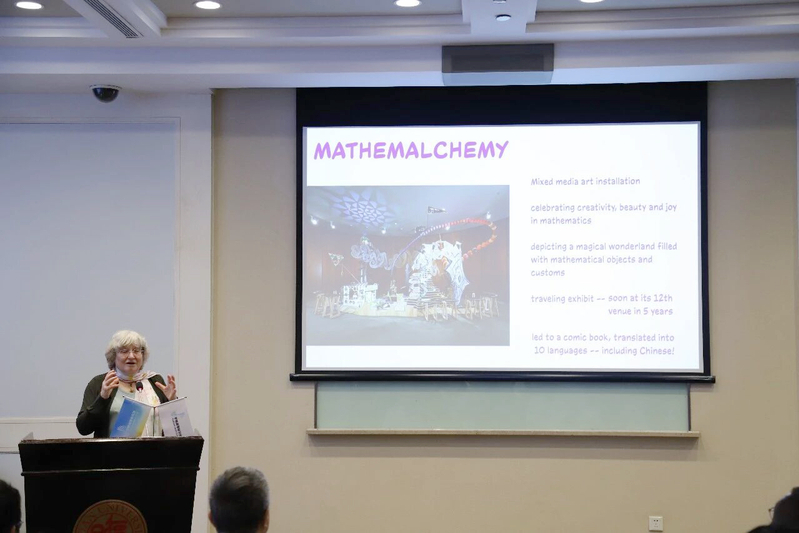
Her recipe for interdisciplinary work: be rooted in one discipline, and collaborate with others to gain depth in the rest. “You cannot be shallow and broad,” she said. What matters, she added, is knowing what your collaborators care about. She has done exactly this herself: 24 mathematicians and artists worked as equals to create Mathemalchemy, a large-scale mixed-media art installation; whoever was puzzled asked, and whoever proposed explained.
Rooted in one discipline, reaching into diversity, and doing both through curiosity, resilience, and collaboration — this is how Daubechies has spent her career, and also the advice she left with the audience.
(END)
Writer: LYU Yanyan
Editor: LI Yijie, Wang Mengqi